
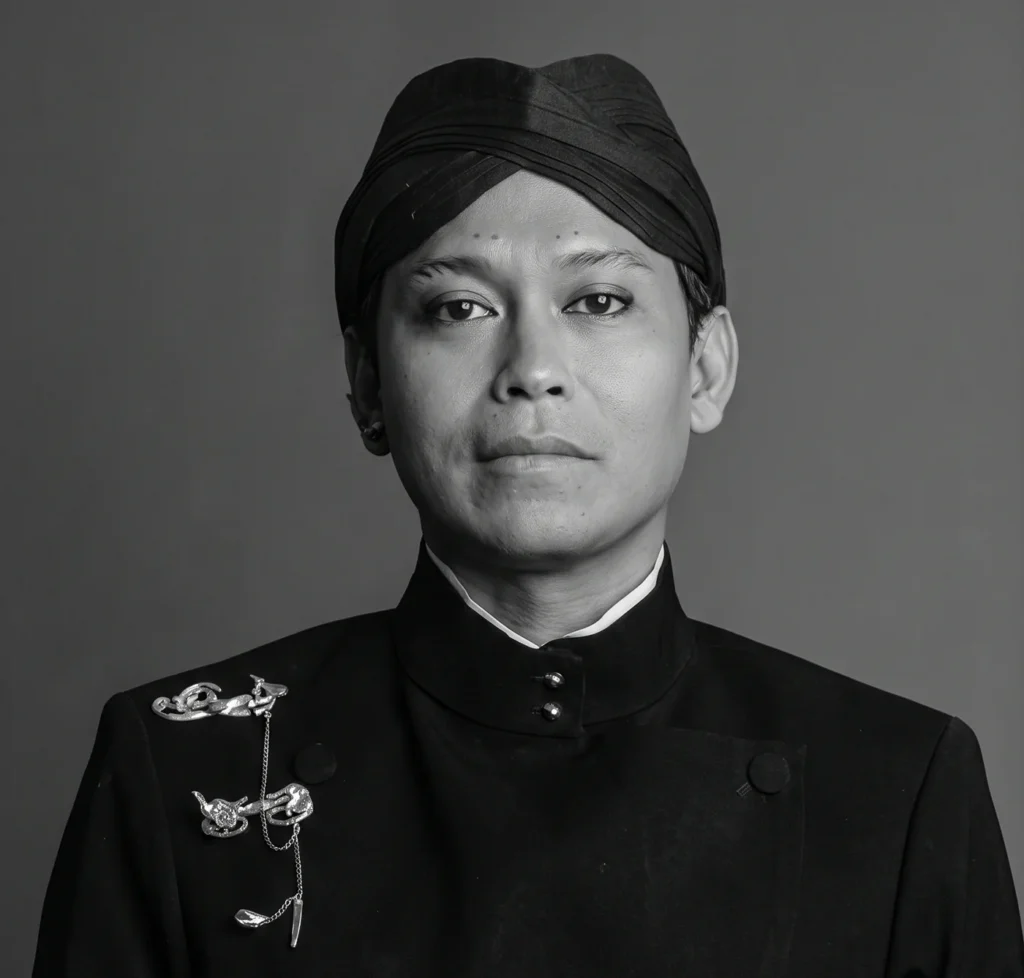
The Mind Behind the Soil Supplying Baliʼs Best Kitchens.
Bali’s dining scene gets a lot of love for its food and atmosphere, but the people growing what ends up on the plate rarely get the same spotlight. Rama is one of them. As the co-founder and COO of Island Organics Bali, growing organic vegetables and herbs for kitchens across the island.
His path here isn’t the usual one. Trained in forestry and botany, Rama spent years working with ginger and aroid plant families, breeding heirloom varieties, and developing his own hybrids. He’s been obsessed with orchids since he was 12, co-authored two books on native Indonesian orchids, and is active in the Indonesian Orchid Society. Before that, he led R&D at Mekarsari Fruit Garden, the world’s largest fruit garden collection, digging into forgotten tropical varieties most of us have never heard of. We sat down with Rama for a chat about a farmer’s life and what it really takes to keep Bali’s kitchens stocked with something worth eating.
Q: “You studied Forest Science and Biology, and now work as a horticulturist, so plants have clearly been with you a long time. Where did it all start? Was there a specific moment that really sparked it?“
A: I actually spent quite some time trying to answer that question. When we were kids, I think we all had that one thing we loved collecting. Some people would collect comics, Tamiya, or figures. Mine were plants, specifically palms and aroids, and eventually I ended up working with orchids up until now.
Q: “With so many local farmers around Bali, what makes Island Organics Bali different, in how you grow, what you grow, or how you work with kitchens?“
A: What makes us different is that we’re constantly experimenting with what could be grown in Bali. A lot of our work focuses on crops that aren’t commonly found in our market, sub-tropical and temperate crops people assume couldn’t thrive in a tropical climate.
Bringing those crops to thrive takes years of trial and error, testing countless combinations of seed sources, varieties, and cultivation methods before finding what actually works here (and it’s still ongoing).
Interestingly, we didn’t start growing these crops simply to be different. Our original goal was to increase biodiversity, one of the foundations of bio-intensive and natural farming. Over time, that philosophy led us to “novelty” crops that chefs couldn’t easily source elsewhere.
But I think the bigger difference is how we work with people. We’ve never seen ourselves as a supplier selling goods to kitchens. We’ve become part of Bali’s F&B community, so we try to understand how chefs actually work, their cuisine, their creativity, the challenges they face, and what they need from us. At the same time, we help them understand the realities of farming: seasonality, crop cycles, and why some varieties perform better than others depending on climate and elevation.
Q: “You spent your university years at IPB, then five years in R&D at Taman Buah Mekarsari, both in Bogor, West Java. So how did Bali even come into the picture? What brought you here, and what made you want to get involved with Island Organics Bali?“
A: The initial reason was actually quite personal: I wanted to have a child, and Bali felt like a place where I could see that.
Professionally, I was looking for something aligned with my background in horticulture. What’s always interested me isn’t just the science itself, but how communities are built around it. I’ve always been drawn to community-based ecosystems where people are connected by a shared passion. When I came to Bali, I realized many of its businesses and local initiatives are highly community-driven. That’s what eventually led me to Island Organics Bali. Beyond producing vegetables, what attracted me was its community-based approach and the relationships with partner farmers and customers built around genuine community rather than conventional business transactions.
It’s a combination of all three. Curiosity is part of it, chefs inspire many of the ideas, and we’re also solving practical challenges in Bali’s growing conditions. That said, breeding isn’t easy or inexpensive. It requires years of work, significant space, and a lot of patience.
What motivates us differs slightly from conventional commercial breeding. Globally, a lot of crop breeding focuses on making life easier for growers: higher yields, better transportability, longer shelf life, greater uniformity. Those matter, but the end user, the chef or consumer, doesn’t always get the same attention.
We’re interested in a better balance. Longterm, we’d like to develop varieties with exceptional culinary value, better flavour, texture, and eating quality, while still resilient enough to grow well under Bali’s conditions. For now, we do as much R&D as we realistically can, given the regulatory and scale limits smaller farms like ours face compared to large seed companies. We keep experimenting and selecting promising lines to improve what we grow. Hopefully one day we’ll have the capacity to pursue breeding more intensively, not to become a seed company, but to develop varieties truly suited to Bali’s culinary landscape and the people who cook with them.
Q: “Rama, let’s talk about the hybrid crops you’ve been developing, a skill rooted in your years doing R&D at Mekarsari. What’s the main driver behind these hybrids? Are you trying to solve a specific agricultural issue in Bali’s climate, meet direct chef requests for hard-to-source overseas veggies, or is it just satisfying your own R&D curiosity?“
A: Bali actually has a long tradition of collective biodynamic farming, such as Kerta Masa rice cultivation, where farming follows shared ecological principles through a wider agro-climate perspective. Our crops are significantly different, but that philosophy of working with nature rather than against it is something we can learn from.
Day to day, organic pest management isn’t something we focus on heavily. We practice multicrops, which naturally reduces the risk of pest and disease outbreaks. We apply local microorganisms to maintain healthy soil biology and use biopesticides only when genuinely needed. Because the farm is biologically diverse, pests rarely become an uncontrollable problem; they become part of the ecosystem rather than something we try to eliminate entirely. Some arthropods we collect even become feeders for our chickens, so theyʼre integrated into the farm system.
Q: “You were among the early pioneers here, moving away from synthetic chemical pesticides. How difficult was it to establish those natural farming practices at first, and what does managing pests organically actually look like day-to-day on the farm?“
A: I think the biggest challenge wasn’t actually the farming techniques; it was changing people’s mindset.
In Indonesia, farming is still highly dependent on manual labour, and most farmers have been trained in conventional agriculture since the 1980s. Theyʼre used to solving problems with synthetic fertilizers and chemical pesticides. Natural farming requires a completely different way of thinking, and changing that mindset alone can take years.
Q: “Let’s talk about the rising success of Bali’s restaurant scene. As Bali’s dining scene expands right now, how might that shift affect local family farms and producers? Where do you see the main disconnect between what restaurants expect and what farms can actually deliver, and how do we bridge that gap?“
A: It’s important to understand the context behind “local family farms.” In Bali, most agricultural businesses are family-based, with a very different structure from commercial farms.
When we talk about “farmers” in Indonesia, we’re usually talking about grower experts. They’re highly skilled in the field, but most have never been exposed to the broader food system: market demand, supply chains, pricing, or how restaurants operate. In most Western countries, farming is a bigger enterprise. Here, it’s often seen as exclusive field labor at the end of a long supply chain.
Historically, that connection has almost always been mediated by a middleman. I don’t think middlemen are inherently bad; a good one plays an important role. The problem is when the supply chain becomes long-winded, and farmers and end users stop understanding each other.
A chef may ask for consistency, specific varieties, or a particular flavor profile, while many farmers have never seen how those ingredients are used in a professional kitchen, let alone eaten at the restaurants they supply. So it’s hard for them to understand why one type of romaine is preferred over another, or why harvest timing matters. On the other side, restaurants often don’t understand the realities of farming: seasonality, weather, pests, the limits of growing naturally.
We spend our time translating between both worlds. We help chefs understand farming, and we help farmers understand what creates value in the kitchen: quality, flavor, consistency, culinary application, not just yield. We take the same approach with our partner farmers. We don’t just ask them to grow crops for us. We provide technical support, share knowledge, and guarantee the market, while they build skills beyond cultivation itself. Growing is an art, but farming is a business.
So as Bali’s restaurant scene grows, I don’t think the opportunity is simply to buy more from local farmers. The real opportunity is to rebuild a relationship that never truly existed in the first place. Stronger communication and fair partnership between farms, intermediaries, and kitchens makes the whole food system stronger, for restaurants and farming communities alike.
Q: “Finally, agriculture in Bali is facing a massive generational crisis—young people are moving toward hospitality, farmers are getting older, and farmland is being sold off. In the long run, this directly threatens our F&B industry. How can we make agropreneurship attractive and financially secure for the next generation, so Bali doesn’t lose its farming foundation?“
A: The first step is changing the image of farming itself. Farming has to become something people aspire to – not something they feel they have to do because they have no other option. In other words, farming has to become “sexy.” Interestingly, we’re already starting to see that shift, especially among expatriates and people who’ve been exposed to agricultural systems in Europe, Australia, or North America. They often see farming as innovative, entrepreneurial, and closely connected to sustainability and food culture. The challenge is that many young Indonesians simply don’t have the same exposure.
At Island Organics Bali, we manage farming to be creative, knowledge-driven, and commercially viable; on top of that, we’re also realistic. We’re a civil-owned entity – we’re not policymakers. We don’t create regulations, subsidies, or national agricultural programs. Many organisations, NGOs, and initiatives are helping to move things forward, but without supportive policies, these efforts can only go so far.
I believe the most effective way to attract the next generation is to position agriculture as an essential part of Bali’s hospitality industry, rather than treating it as a completely separate sector. Farming shouldn’t sit outside the food and beverage ecosystem – it should be recognised as one of its foundations. Every successful restaurant begins with great ingredients, and every great ingredient begins with a sustainable farm.
As for concerns about shrinking farmland, I’m actually a little less pessimistic than many people. Indonesia has experienced a dramatic decline in the percentage of its population working in agriculture since independence, yet we haven’t experienced widespread food shortages because agricultural productivity has also improved through intensification and better technology.
For me, the bigger conversation isn’t only about producing more food – it’s also about treating food wiser. The end user especially, plays a major role. Reducing waste, valuing seasonal produce, and consuming more efficiently are just as important as increasing production. A resilient food system depends on both sides: farms producing responsibly and consumers appreciating and using those products responsibly.
Ramadani Yudha Prasetya
Co-founder and COO of Island Organics Bali


